
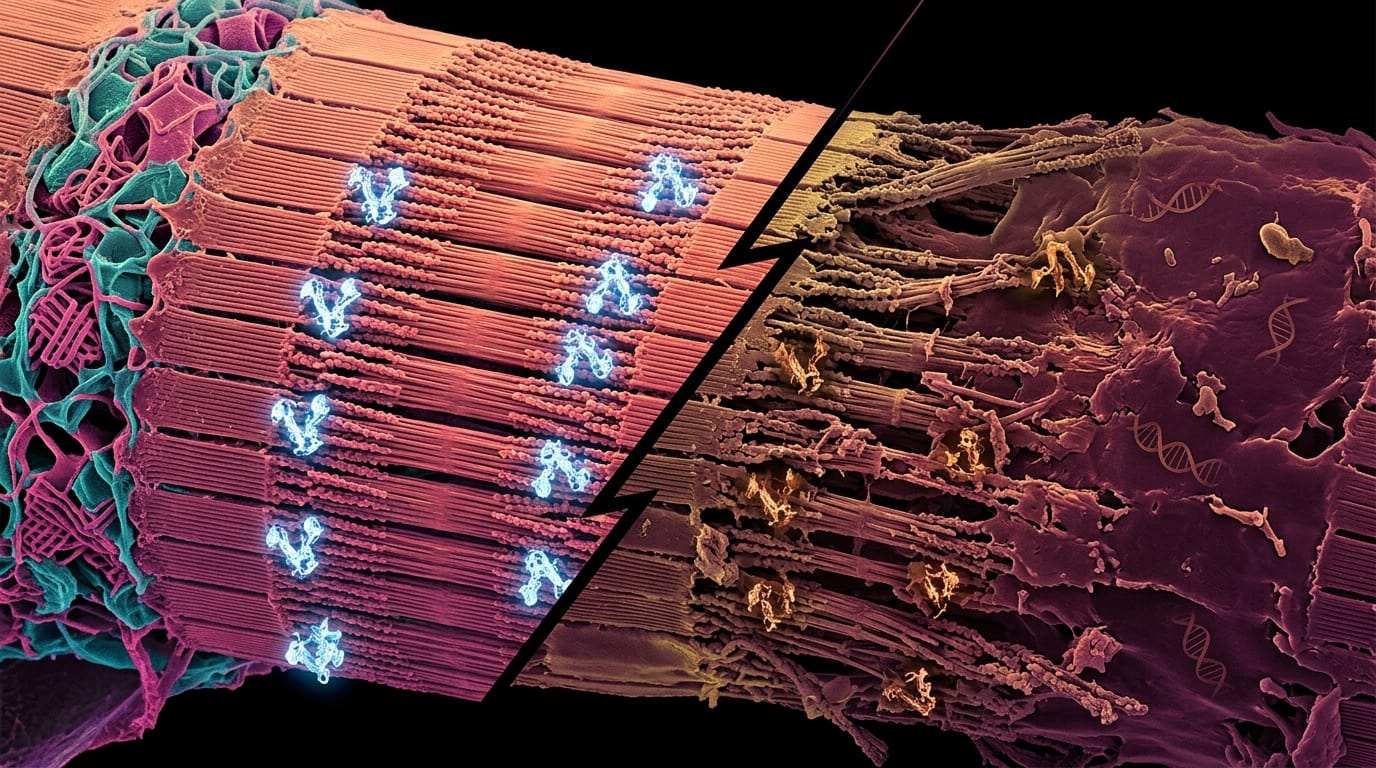
Our muscles carry us through life, letting us walk, lift, and maintain our balance. However, aging frequently diminishes the strength and bulk of these vital tissues. This age-associated decline, known as sarcopenia, is a major challenge in health, contributing to frailty and a reduced quality of life for millions. For a long time, scientists have documented the physical changes in aging muscle, but exactly how these changes happen at a tiny, molecular level has remained a puzzle.
Think of proteins as the tiny machines that do almost all the work inside our cells. They build structures, carry messages, and make everything happen. But these machines aren’t static. After a protein is made, it can get chemical tags added to it. We call these tags post-translational modifications, or PTMs for short. These PTMs are like switches or dimmer knobs. They can turn a protein's activity up or down, change its shape, or even tell it where to go in the cell. They are crucial for healthy cell function, including within our muscles.
The key thing to understand here is that these tiny chemical adjustments profoundly influence how our cells—and our muscles—work. Up until now, our understanding of how these many PTMs change during muscle aging has been incomplete. A team of researchers, led by Li and colleagues from various institutions, decided to build a comprehensive map of these molecular changes.
Their approach was to look at skeletal muscle from both young mice, at three months old, and aged mice, at twenty-four months old. Think of this as comparing a young adult to a very senior individual in human terms. The researchers performed a deep dive into the muscle tissue, systematically identifying 5,337 proteins and mapping thousands of individual PTM sites. They focused on five key types of these chemical tags: acetylation, phosphorylation, N-glycosylation, O-glycosylation, and ubiquitination. This comprehensive molecular picture, which they called an integrated atlas, revealed specific changes that characterize skeletal muscle remodeling—the way our muscles adapt, and often decline, with age. What they discovered was not a simple, uniform process. Instead, different types of PTMs were linked to very distinct biological pathways within the muscle cells.
For example, acetylation and phosphorylation, two of the PTMs they studied, were strongly connected to the body's metabolism—how cells generate and use energy. N-glycosylation, another type of tag, seemed more involved with immune functions. O-glycosylation played a role in muscle contraction, the very process that lets us move. And ubiquitination was tied to the cytoskeleton, the internal scaffolding that gives muscle cells their structure and helps them move.
But the story got even more intricate. The researchers found that these PTMs didn't just act alone. They interacted in complex ways. For instance, the association patterns between acetylation and ubiquitination varied, showing both inverse and similar changes in different groups of proteins. The relationship between phosphorylation and O-glycosylation also wasn’t consistent across different proteins. Even when acetylation and phosphorylation showed positive connections, their age-related changes could still differ in particular subsets of proteins.
Now that we have that detailed molecular map in place, we can connect it to a bigger picture of muscle aging. Think of the critical organelles within muscle cells, like the sarcoplasmic reticulum and mitochondria. These two structures need to work closely together, almost like dance partners, to regulate things like calcium signals and energy production. This close interaction is vital for healthy, efficient muscle function. But with advanced age, this precise partnership often breaks down. The changes Li and colleagues mapped—the specific PTMs they identified—likely drive or modulate these functional impairments, contributing directly to the age-associated muscle decline we see.
The insights from this integrated atlas offer a valuable new resource. They help us understand the molecular alterations that accompany muscle aging and sarcopenia. Future efforts to combat age-associated muscle remodeling will need a variety of strategies. This might involve lifestyle changes, like exercise, and specific nutritional support. It could also lead to exploring novel nutraceutical and pharmacological approaches. From a research standpoint, scientists are moving towards creating complex computer models that can directly link this kind of detailed molecular data with observations of muscle mechanics and function across different scales. This holistic view promises to unlock deeper understanding, paving the way for more effective, personalized strategies to keep our muscles strong and functional throughout our lives, giving us more years of active living. ◆
Sourced from: "Comprehensive multi-post-translational modifications profiling reveals age-associated remodeling in skeletal muscle." by Li, Jian et al.