
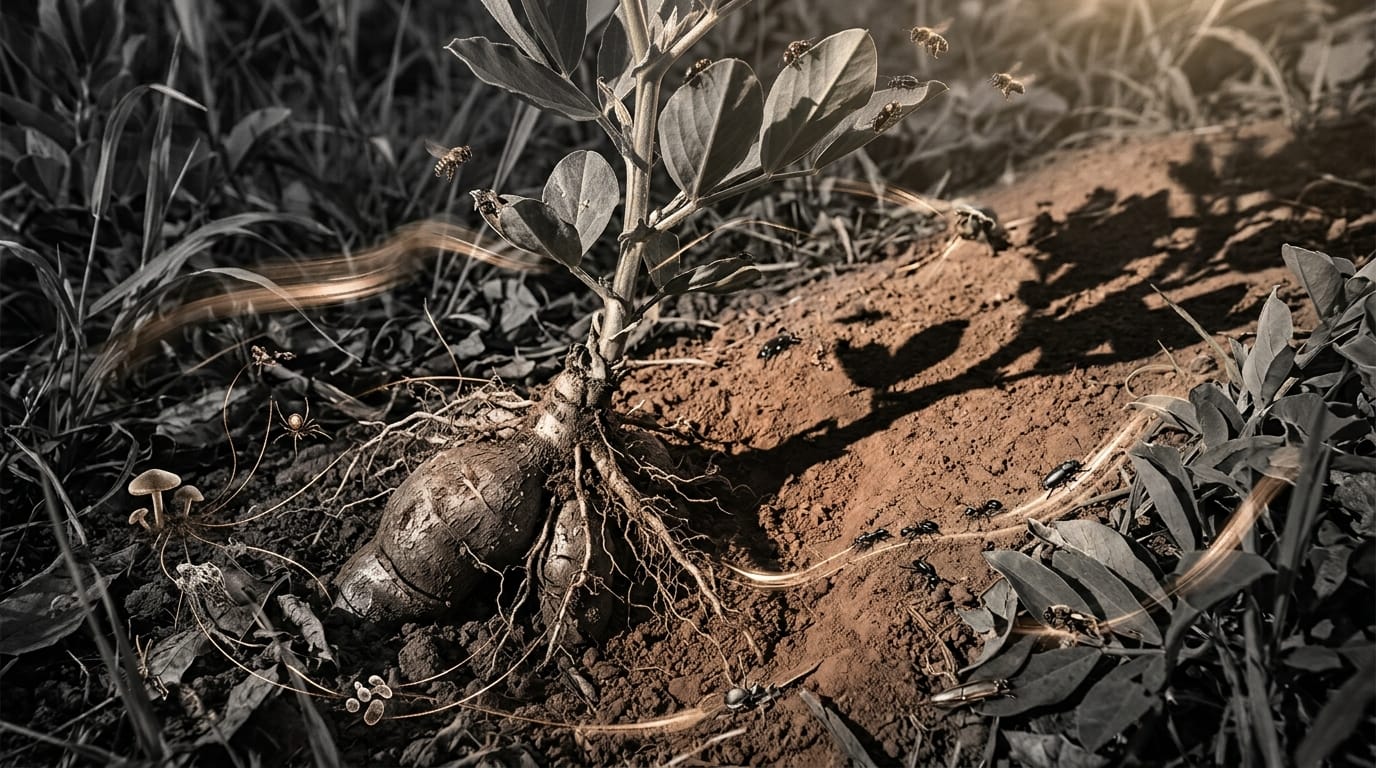
In West Africa, the lives of millions hinge on a humble tuber called Solenostemon rotundifolius, or fabirama. This is no ordinary root crop; it’s a critical food source, especially for families facing unpredictable weather. But climate variability has made growing it a gamble. Farmers plant it, hoping for a good harvest, often unaware of a crucial factor that makes all the difference.
This isn’t just about unpredictable rains or changing temperatures. The real problem often comes down to a hidden interplay that can drastically cut yields and extend the growing season unnecessarily. Many farmers lack specific, hard knowledge about how their particular plant varieties perform when planted at different times of the year. This blind spot leaves food security vulnerable, making it harder to plan and guarantee enough food for the community.
Now, Romaric Kiswendsida and colleagues have pulled back the curtain on this complex relationship, offering a critical roadmap for a more stable food future. Their research focused on Solenostemon rotundifolius, carefully evaluating twelve distinct plant varieties across three different planting dates. For three growing seasons, the team recorded fourteen key characteristics, everything from how the plant’s canopy developed to the size of its leaves, its full growth cycle, and ultimately, its yield.
What they found has direct and immediate implications for those who rely on this crop. They discovered that the yield changes wildly not just from one plant variety to the next, but also depending on when it’s planted. This critical dance between a plant’s inherent traits and the calendar—genotype-by-planting date interactions—dictates how much food ends up on the table. Think of it like a finely tuned instrument: even the best violin won't sound right if the strings aren't properly tightened for the specific piece of music. For fabirama, the tuning is the planting date. This means that picking the right planting date is more crucial for optimizing both the harvest size and the speed of the crop cycle than even the specific plant variety a farmer chooses. It has a higher impact than the plant’s genetic makeup alone, or even the combined effect of genetics and planting time. Without this knowledge, farmers might pick a superb variety but plant it at the wrong moment, losing a significant portion of their potential harvest. The consequence is wasted effort, reduced food, and greater vulnerability.
Understanding how plants respond to their environment is a global challenge. While Solenostemon rotundifolius faces its own specific issues, the broader scientific community is also uncovering the intricate ways other plants, like the "resurrection plant Ramonda serbica, adapt to extreme stress such as severe drying. These studies, although focused on different species, highlight the immense biological strategies plants employ to withstand tough conditions. They underscore why detailed, localized research, like that on fabirama, is so vital. It’s all part of a larger effort to enhance crop resilience in increasingly challenging and unpredictable climates, directly impacting food security across the globe. Similarly, the global picture of how countries manage nitrogen, a cornerstone nutrient for food production, reveals no single right answer. Across 130 countries from 1992-2022, agricultural development shows divergent paths, not a universal "nitrogen transition." This historical observation only reinforces that effective farming solutions, whether for nutrient management or crop planting, require tailored approaches rather than one-size-fits-all mandates. The findings on Solenostemon rotundifolius fit squarely within this context, demonstrating the specific, local adjustments that can drive real improvements in agricultural performance and sustainability.
The message is clear: the exact day a farmer puts fabirama in the ground can make or break a season. This isn't theoretical; it's a matter of calories, income, and survival. Without specific, localized recommendations on optimal planting dates for different varieties, farmers are fighting climate variability with one hand tied behind their back.
The next step is for this specific, evidence-backed knowledge to reach the fields. Agricultural extension services and local farming communities need to collaborate to translate these findings into actionable planting guides, specific to their local conditions and preferred fabirama varieties. equipping farmers with this precise information—not just what to plant, but when—will unlock the full potential of this vital crop, strengthening food security for millions. ◆
Sourced from: "Agronomic Performance and AMMI Stability Analysis of Solenostemon rotundifolius Response to Key Climatic Parameters"