

Imagine trying to calculate the exact cost of adding a single, extremely fussy guest to a massive, bustling party. The guest influences everyone around them, and everyone else subtly shifts to accommodate. It is not just the guest themselves, it is the ripple effect through the entire room. Now imagine that party is not full of people, but billions of molecules, and that "guest is a single ion dissolving in water. The stakes are much higher than awkward small talk, and the calculations involved are often the kind that make supercomputers weep.
This "ripple effect cost, what scientists call chemical potential, is absolutely crucial for understanding things like battery performance or how drugs interact with cells. The hitch is that working out these numbers is incredibly expensive. We are talking about finding the energy required to add a single molecule to a system, which means trying to map out every possible way all the other molecules could arrange themselves in response. It is like trying to predict every conversation, every spilled drink, every sudden dance-off at that molecular party. The problem gets especially tricky when the system is complex, like an electrolyte liquid, because the differences between how the system looks before and after the new molecule arrives can be so extreme that their arrangements barely overlap. It is like trying to see the similarities between a quiet dinner party and a full-blown rave, when you only have snapshots of each. Trying to bridge that gap with existing computing methods can take forever.
For years, scientists have been working on tools to speed up these free energy computations, including something called normalizing flows. Think of normalizing flows as clever computer programs designed to smoothly transform one molecular arrangement into another, making those difficult-to-calculate changes a little easier to see. They are powerful, these flows, but also notoriously complex. Training them to do their job often takes a significant amount of computing power and time. It means you cannot just whip one up for every new molecular system you want to study. And when applied to liquids, these sophisticated programs have only offered modest improvements, sort of like bringing a super-fancy espresso machine to the party, only to find everyone still prefers instant coffee.
This is where the story gets interesting, and a little counterintuitive. The idea is to focus on a really good, simple pour-over method, rather than building the most complex, all-knowing espresso machine. That is the core idea behind a new approach called "minimal normalizing flow," or MNF. Philippe Baron, in a preprint appearing on arXiv, describes how this method turns the usual approach on its head. Instead of aiming for maximum complexity, MNFs deliberately limit their own flexibility. They are designed to be simple, trainable mappings.
The genius of MNFs is that they do not try to transform everything at once. They apply what the researchers call "physically informed transformations." Imagine that fussy guest joining our molecular party. Instead of trying to model every single interaction, MNFs focus on a few key, physically sensible changes. For example, when an ion dissolves in water, the water molecules tend to arrange themselves in specific shells around it. An MNF might focus on mapping just these radial arrangements, or how the water molecules align themselves, rather than trying to map every single jiggle of every molecule. It is like only paying attention to how people cluster around the guest, and how they orient their bodies, ignoring the color of their shoes.
This focused, simpler approach has dramatic results. Useful minimal normalizing flows can be trained in about one minute of GPU time. This speed means it is suddenly practical to create these tools on-the-fly for entirely new systems, instead of spending days or weeks preparing a complex model. It significantly accelerates calculations of chemical potentials, especially in basic model systems like Lennard-Jones particle systems, which are simplified representations of atoms or molecules, like perfectly smooth, perfectly spherical billiard balls that only interact when they get close. For these systems, MNFs speed things up by at least ten times.
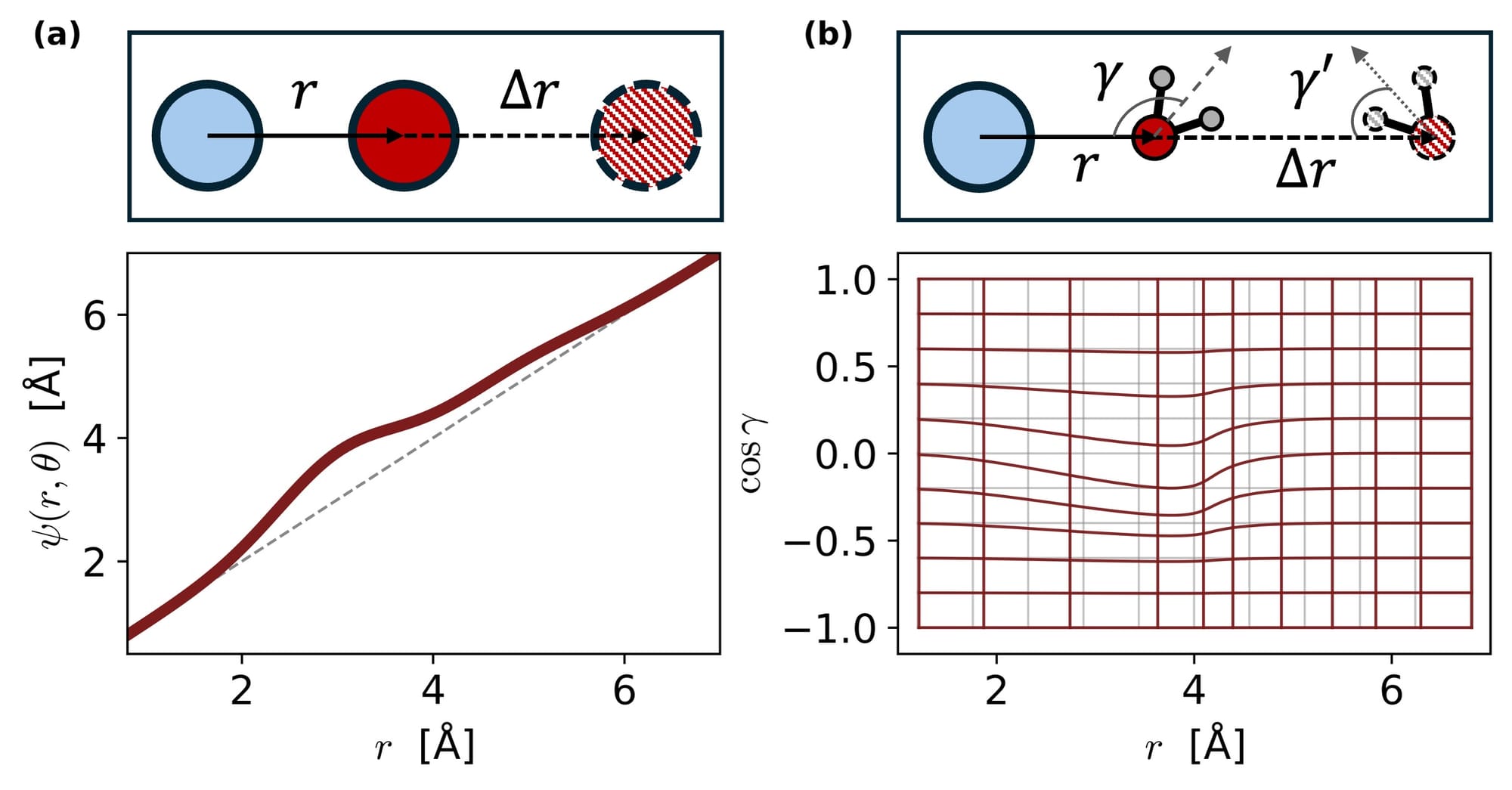
For more complex scenarios, like understanding how ions behave in water, where scientists calculate the charging free energy — the energy needed to add an electric charge, like bringing a tiny battery into the water — MNFs prove their worth by increasing the effective sample size by three times. Think of it this way: to get a reliable measurement, you often need to run many simulations. MNFs help scientists get the same quality of result with three times fewer simulations, or far better results from the same number of simulations. And when scientists look at how changing the interaction rules, or force field perturbations, affects a system, MNFs increase that effective sample size by eight times, offering even more significant gains.
These numbers mean faster simulations, which mean faster insights into everything from drug discovery to designing better industrial catalysts. It means unlocking secrets that were previously hidden behind enormous computational walls. While this work provides a strong foundation, the researchers themselves point out that it is the first step toward developing even more sophisticated, physically-informed mappings for incredibly complex free energy calculations.
So, the next time you pour yourself a glass of water, or charge your phone, remember the silent, incredibly complex dance happening at the molecular level. And remember that sometimes, the quickest way to understand the universe's most intricate secrets is not with the biggest, most powerful tool, but with one that is designed to be elegant, focused, and minimal. It is a reminder that sometimes, less really is more, especially when you are trying to speed up the conversation of a billion tiny particles. ◆
Sourced from: "Accelerating Chemical Potential Calculations with Minimal Normalizing Flows"