
Humanity, for generations, looked to the night sky, observing light in its many forms. Then, just under a decade ago, a different sense awoke within us, one capable of perceiving the universe through the subtle shudder of spacetime itself. What was once an almost impossible whisper, the direct observation of gravitational waves, has grown into a chorus, with detections now occurring nearly every day. This shift from rare, monumental discovery to a steady rhythm of cosmic signals marks a new era in our understanding of the universe.
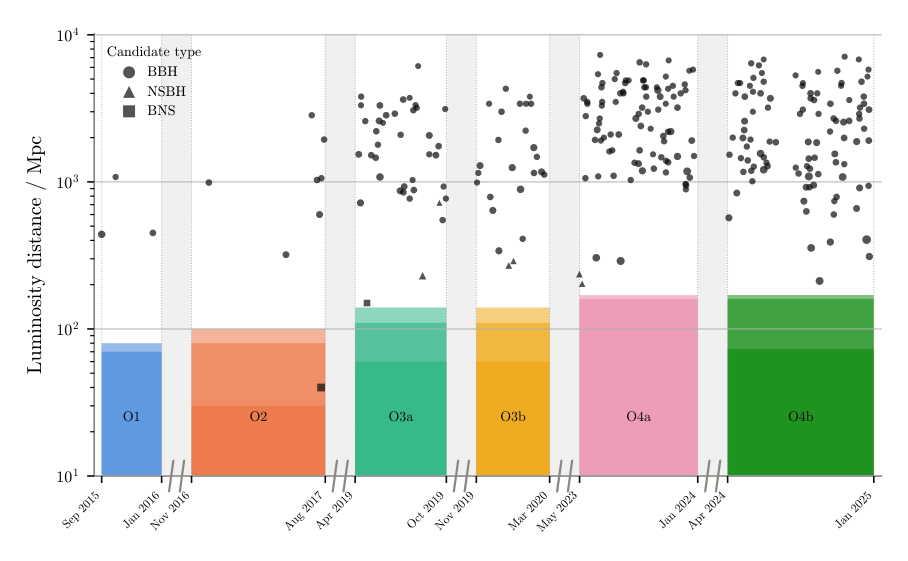
The intricate ears listening for these ripples belong to the LIGO-Virgo-KAGRA (LVK) network, a global collaboration of observatories. Imagine kilometer-long tunnels in places like Washington State, Louisiana, Italy, and Japan. Within these precisely engineered structures, lasers measure distortions in the fabric of space and time, changes so minute they are far smaller than an atomic nucleus. These highly sensitive instruments, working in concert, form a unique astronomical tool, one that began its pioneering work with the first direct detection of gravitational waves in 2015. The latest chapter in this cosmic listening project unfolds through the fourth observational run, known as O4. This period, particularly its second part, O4b, which spanned from April 2024 to January 2025, has greatly expanded our sonic map of the universe. Within this recent surge, the LVK network identified 161 new candidates for what scientists call merging compact binaries — pairs of incredibly dense stellar remnants, like black holes or neutron stars, spiraling inward and crashing together. Of these, 104 possess a confidence level high enough to consider their astrophysical origin virtually certain, meaning they are actual events in the cosmos, not terrestrial noise. All of these newly identified certain events are understood as mergers of paired black holes. These numbers accumulate rapidly, painting a more complete picture of the gravitational-wave sky. With the new insights from O4b, and updated analyses from the first part of the run, O4a, the total count of high-confidence astrophysical gravitational-wave transients now reaches 390. This significant growth stems from the steady improvement in the network's detector sensitivity. During O4a, for instance, the LVK network could effectively scan a volume of space for binary neutron star mergers 3.5 times larger than in the prior observing run. This enhanced capability allowed the observatories to announce an average of almost one gravitational-wave event alert each day.
Some of these signals speak with particular clarity. The fourth observing run delivered five binary black hole mergers whose combined network signal-to-noise ratios, a measure of how clearly a signal stands out from background noise, exceeded 30. One event, named GW250114_082203, produced a network signal-to-noise ratio of 76.9, an exceptionally loud echo from the distant universe. Such clear signals allow for a more precise study of their properties, offering new opportunities to test the fundamental theories of gravity that govern them.
The sheer volume of these detections allows for a deeper understanding than any single event could provide. Gravitational-wave science has evolved beyond the singular moment of discovery. Significant advances now emerge from what are called population-level analyses. Instead of focusing on isolated instances, researchers examine these large catalogs of events to discern overarching patterns and characteristics of the sources themselves. These analyses help to constrain the astrophysical distribution of merging compact binaries, shedding light on how these extreme objects form and evolve across the cosmos. They also offer ways to test the very framework of General Relativity, the theory describing gravity, and even to refine our understanding of the expansion rate of the universe.
The second part of the fourth observing run, O4b, has contributed a trove of specific details. The newly identified binary black hole mergers, for example, reveal component masses ranging from 5.14 times the mass of our sun to as heavy as 70 solar masses. These specific measurements, derived from the careful work of researchers like Christopher P L Berry and Daniel Williams, who recently presented a catalogue of insights from this run in a preprint appearing on arXiv, provide crucial data points for these population studies.
This global endeavor also upholds a commitment to open science. Data and analysis results from the LVK network, including the newly released information from O4b, are made publicly available through the Gravitational Wave Open Science Center. This practice allows for broader scientific inquiry and independent verification, ensuring that the insights gained are accessible to the wider research community.
The continuous expansion of the Gravitational-Wave Transient Catalog reflects a profound and evolving view of the universe through this novel window. This work is deeply woven into the larger fabric of multi-messenger astronomy, which seeks to combine observations across all cosmic messengers, from light to neutrinos to gravitational waves. Efforts during the third observing run, for example, involved a deep search for joint sources of gravitational waves and high-energy neutrinos, aimed at understanding cosmic processes like the outflows from compact object mergers. While that particular search did not identify significant joint sources, it established important constraints on their rates, illustrating the sustained drive for complementary observations.
The complete catalog from the fourth observing run is still being assembled and refined, with a full release scheduled for December 2026. Future observing runs are already in planning, promising even greater detector sensitivity. These will undoubtedly yield even larger catalogs and more of those exceptionally loud signals. We are learning to listen more closely, to perceive more distinctly the deep vibrations of a universe continuously shaped by its most violent and ancient events. The world is older and stranger than we often remember. Each ripple in spacetime, carefully observed, reminds us of its immense, hidden song. ◆
Sourced from: "A catalogue of insights from the fourth LIGO-Virgo-KAGRA observing run" by Christopher P L Berry and Daniel Williams