
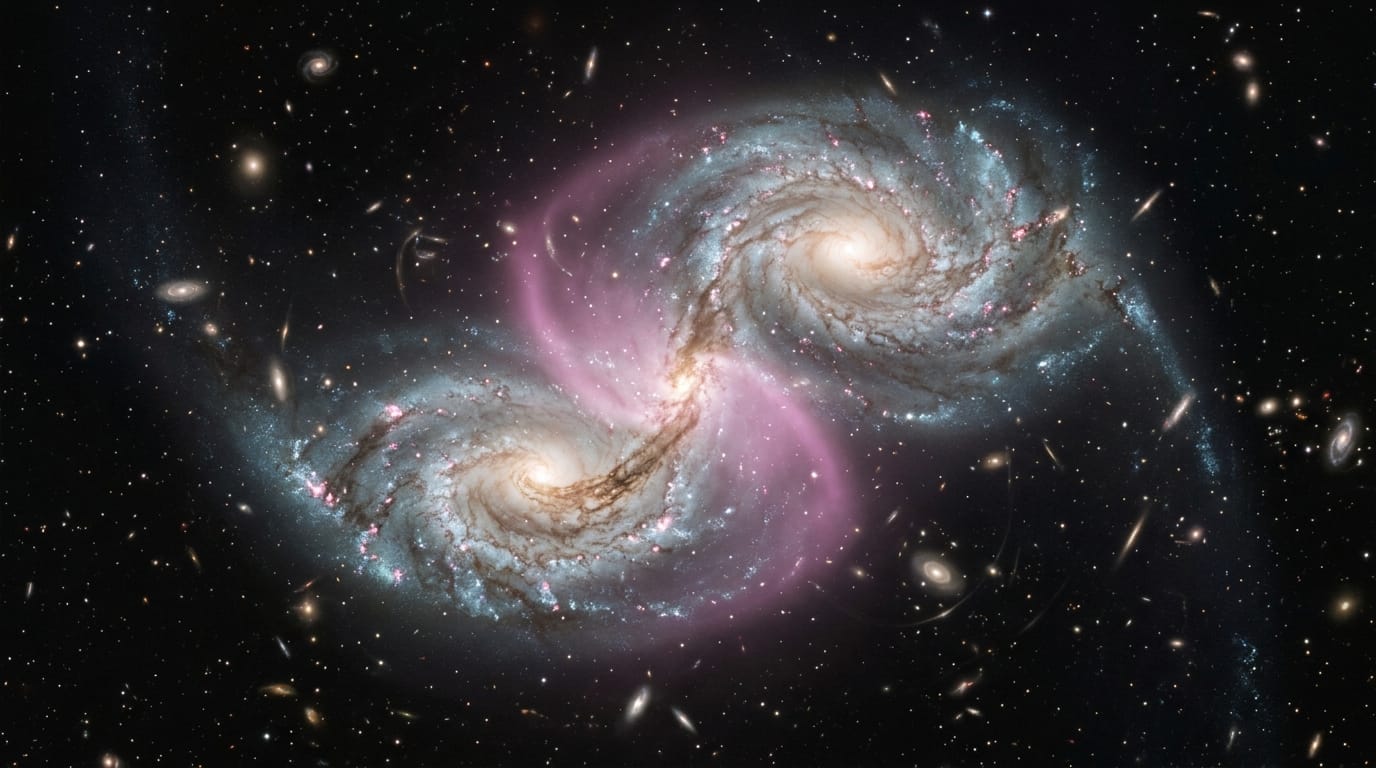
Looking into the distant sky, past the familiar patterns of stars in our own galaxy, we see other galaxies, immense islands of stars that stretch for hundreds of thousands of light-years. Sometimes, we catch them in the act of transformation. One such cosmic event, observed in the faint glow of X-rays, reveals two colossal collections of galaxies, each home to thousands of star systems, locked in a slow, immense embrace.
The particular object is known as RXC J0032.1+1808. Its shape in X-ray light, appearing with two distinct bright regions, suggests it is currently undergoing a process known as a galaxy cluster merger—a collision of unimaginable scale between these vast cosmic structures.
Our eyes perceive visible light, a narrow band of the electromagnetic spectrum. But the universe also shines in other ways, emitting light at energies far higher than we can detect directly. The European Space Agency's XMM-Newton observatory, a telescope orbiting Earth, is designed to capture these high-energy X-ray photons that stream from intensely hot regions of space. By collecting these X-rays, XMM-Newton allows us to map the distribution of gas heated to millions of degrees, gas that glows brightly as it is compressed and agitated during a cosmic collision.
From existing XMM-Newton data of RXC J0032.1+1808, researchers could discern characteristics of this hot gas. Its overall X-ray temperature, a measure of the average energy of the particles within it, was estimated at 8.5 units of kilo-electron volts, or keV, with a careful assessment of uncertainty placing the true value between 7.6 and 9.6 keV. A kilo-electron volt quantifies the energy carried by individual particles or photons, a unit far greater than the electron volts describing visible light. This intense heat causes the gas to radiate X-rays with significant power. The total X-ray luminosity, the amount of energy emitted in X-rays each second, was found to be approximately one hundred and four million billion billion billion ergs per second. An erg represents a tiny unit of energy; to grasp the magnitude, one must consider that number, 1.04 multiplied by ten to the power of forty-five, for a moment. This radiation was observed across a specific slice of the X-ray spectrum, spanning from 0.5 to 10.0 keV.
Knowing the temperature and brightness of the gas provides a snapshot, but to understand a collision, one needs to understand motion. For this, astronomers turn to other forms of light. By carefully analyzing the light from galaxies within each of the two merging clusters, a process called a redshift survey can reveal how quickly these subclusters are moving along our line of sight—that invisible line stretching from us to the object. Just as the pitch of a siren changes as it moves towards or away from you, the light from distant objects shifts in color depending on their motion. A shift towards the red end of the spectrum means the object is receding. For RXC J0032.1+1808, this survey suggested a relative velocity between the two subclusters of 76 kilometers per second. This figure, however, carries a significant range of uncertainty, reaching as much as plus or minus 364 kilometers per second, meaning the true relative speed along our viewing path could be anywhere from receding slowly to approaching at a moderate pace.
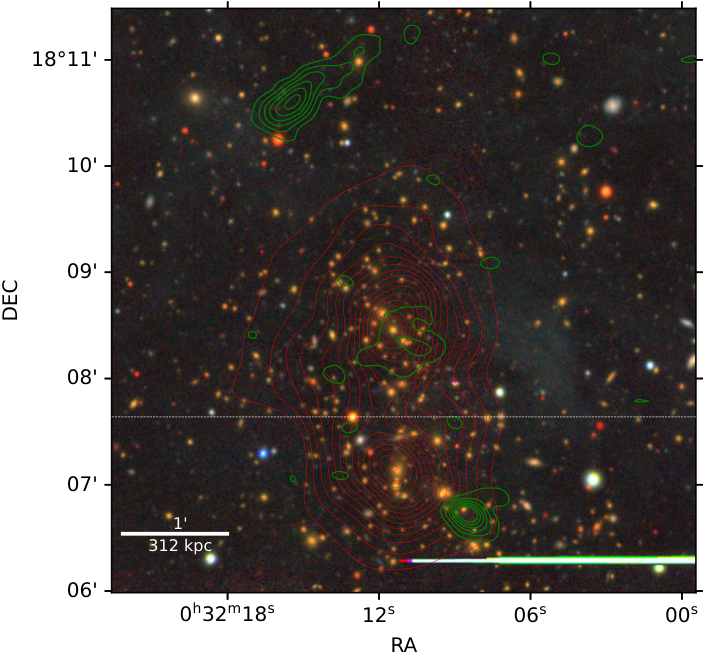
Observing the present state of a cosmic collision is like seeing a still image from a vast, slow-motion drama. To reconstruct the full play, scientists employ hydrodynamic simulations. These are sophisticated computer models that take into account the immense gravitational forces and the complex physics of gas and dark matter to project how such a merger would unfold over cosmic timescales. David Wittman and colleagues, whose work appeared in a recent preprint on arXiv, used such simulations to interpret the observations of RXC J0032.1+1808. The models indicated that this was not a straightforward, head-on impact. Instead, the two galaxy clusters had already made their first closest passage, an event scientists refer to as the first pericenter. The simulations suggest we are observing the system a substantial period after that initial close encounter—somewhere between 395 and 560 million years following the first pericenter. This is a span of time longer than the entire age of the dinosaurs on Earth.
Further, the simulations revealed an important detail about our perspective. Our line of sight to RXC J0032.1+1808 means that the apparent separation between the two merging subclusters is foreshortened, compressed by a factor of about two, compared to their actual distance apart in space. It is a bit like looking at a road from a high hill; a long, winding path might appear much shorter than it is in reality. This foreshortening complicates the direct measurement of their true separation and relative motion, underscoring the necessity of these complex simulations. The system also shows evidence of a radio relic, a giant shockwave of radio emission, another signature that it is observed after its closest approach.
The ongoing merger of RXC J0032.1+1808 offers a particular window into the immense, drawn-out violence that shapes the largest structures in our universe. It is a slow ballet of gravity and gas, playing out over hundreds of millions of years, far from any human lifespan. To piece together its story requires not only powerful telescopes but also patient attention—a careful gathering of faint X-ray whispers and subtle shifts in starlight, then a reconstruction through the logic of physics, revealing a cosmic history that continues to unfold, older and stranger than our everyday world. And in that attention, we begin to feel the scale of this reality, vast and quiet and immense. ◆
Sourced from: "A Very Rich Bimodal Galaxy Cluster Merger: RXC J0032.1+1808"