
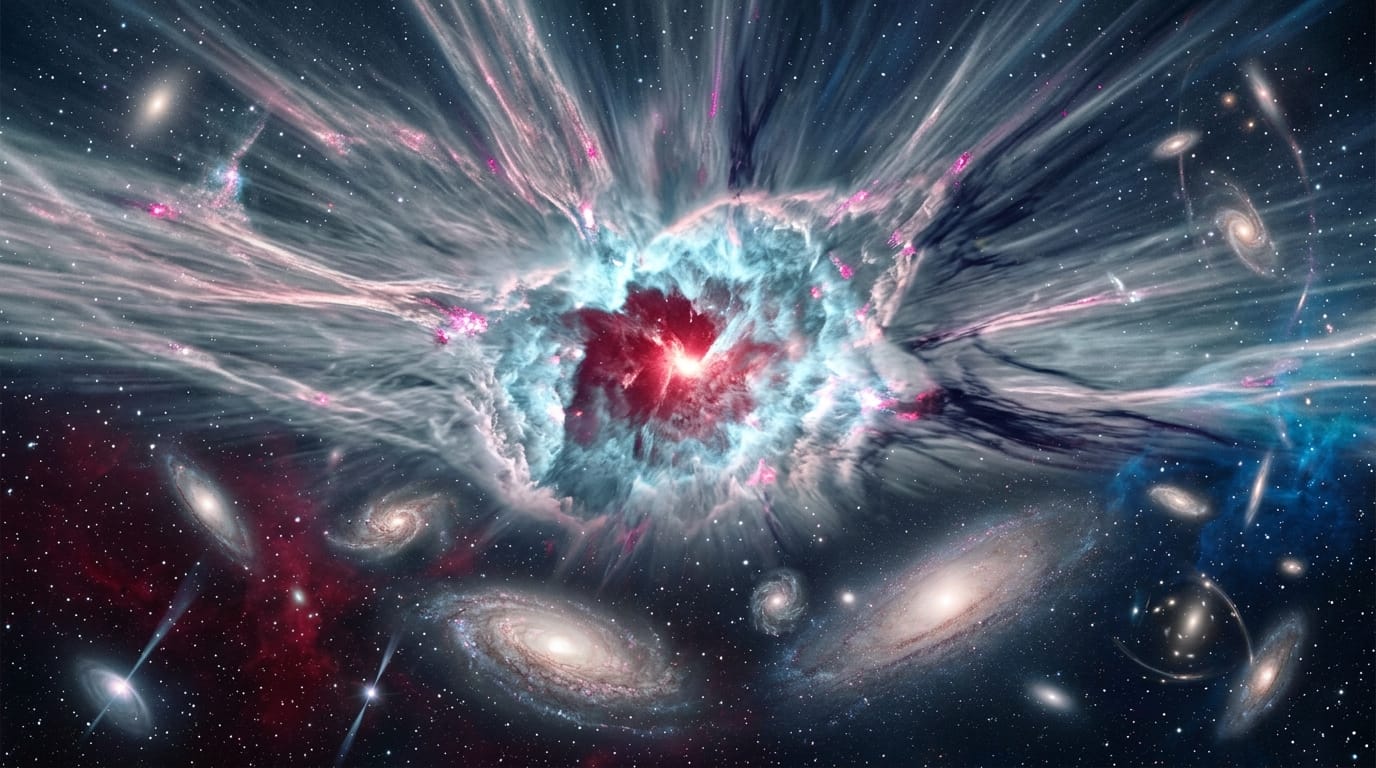
A cosmic disagreement echoes through the halls of astronomy. For years, scientists measuring cosmic expansion have arrived at different numbers, depending on whether they look at the cosmos in its infancy or in its more recent past. This persistent puzzle, often called the Hubble tension, suggests a fundamental misunderstanding of the universe or a missing piece in our models. Perhaps the universe has a hidden history of acceleration. One intriguing idea to reconcile these measurements involves a brief burst of what scientists call a transient form of dark energy. Imagine the universe, only a few hundred thousand years old, receiving a temporary extra push, like a silent, unseen accelerator briefly engaged before quickly fading away. This surge would have slightly sped up the universe’s expansion rate at a critical moment, just as the first atoms were forming and light was freely escaping. Such a fleeting force would leave subtle but distinct imprints on how the large-scale structures of the cosmos, like vast clusters of galaxies, grew and assembled over billions of years.
To search for these imprints, scientists turn to powerful instruments like the eROSITA X-ray telescope, carried aboard the Spectrum Roentgen Gamma (SRG) mission. From its perch in space, eROSITA performs an all-sky survey, mapping the X-ray universe. It detects the faint, diffuse X-ray glow emanating from the superheated gas trapped within galaxy clusters. These clusters are the largest gravitationally bound structures in the cosmos, each containing hundreds or thousands of galaxies, along with immense clouds of gas that reach temperatures of millions of degrees, hot enough to emit X-rays. By observing these distant cosmic behemoths, eROSITA provides a unique window into the growth of the universe’s structure.
The first All-Sky Survey from eROSITA, known as eRASS1, delivered a uniformly selected sample of 5259 galaxy clusters. These clusters stretch across vast cosmic distances, their light taking billions of years to reach us. When light travels across the expanding universe, its wavelengths are stretched, shifting it toward the red end of the spectrum. This phenomenon is called redshift, and a higher redshift number indicates a greater distance and an earlier time in the universe’s history. The eRASS1 clusters span a redshift range from 0.1 to 0.8, offering a broad view of cosmic evolution.
A team led by J. Strunk and colleagues, in a preprint appearing on arXiv, used a carefully selected subsample of these eROSITA clusters, those with redshifts between 0.1 and 0.45, to place the first constraints on the Early Dark Energy scenario using cluster number counts. By observing how many clusters of a certain mass exist at different distances, the researchers could infer details about the universe’s expansion history and the forces that shaped it.
Using the eRASS1 cluster number counts alone, they established an upper limit on the maximum contribution of Early Dark Energy. Their analysis suggested that this extra energy component, if it existed, could not have contributed more than 30 percent of the total energy density of the universe during its brief active phase.
To refine these findings and achieve a more comprehensive understanding, the team expanded their analysis. They combined the eROSITA cluster data with a suite of other cosmological probes. This included primary measurements of the Cosmic Microwave Background, the faint afterglow of the Big Bang, which offers a snapshot of the universe in its infancy. They also incorporated data from baryon acoustic oscillations, which reveal the subtle, recurring patterns in the distribution of galaxies, acting as a cosmic ruler. Further, they used information from CMB lensing, which measures how the light from the Cosmic Microwave Background was subtly bent by the gravity of intervening matter. For calibrating the masses of the galaxy clusters, they integrated weak lensing data from the Dark Energy Survey (DES Year 3), KiDS, and HSC. This combined approach allowed them to cross-verify their findings and strengthen their conclusions. Notably, this joint analysis intentionally excluded any data derived from distance-ladder calibrations, which are the very late-universe measurements that initially contributed to the Hubble tension.
This comprehensive joint analysis provided a more precise estimate for the Early Dark Energy fraction. The researchers found its contribution to be 0.10, with an uncertainty range spanning from -0.03 to +0.04. This represents a significant detection, measured at approximately 3.2 sigma.
The combined analysis also yielded a specific value for the universe’s current expansion rate, known as the Hubble constant. They determined it to be 71.4 kilometers per second per megaparsec, with an uncertainty of 1.4. This means that for every megaparsec—a distance equivalent to about 3.26 million light-years—an object is from us, it recedes 71.4 kilometers per second faster. This value aligns more closely with the measurements derived from observations of the universe’s later history.
The findings from eROSITA’s galaxy clusters, woven together with other threads of cosmic evidence, suggest that Early Dark Energy could indeed be a component of our universe's history. It offers a potential path toward resolving the long-standing discrepancy in the universe's expansion rate. The cosmos continues its slow, majestic unfolding, and our patient attention reveals new details in its vast, intricate design. The universe holds more than its visible form. ◆
Sourced from: "The SRG/eROSITA All-Sky Survey. Early dark energy and Hubble constant from the cluster mass function"