

Imagine trying to understand how a skyscraper behaves in an earthquake, but your only tools are either a diagram of every atom or a child's drawing of the building. The lack of tools at intermediate scales, in a slightly exaggerated way, is the decades-old problem for materials scientists. The universe, in its infinite wisdom, operates on wildly different scales. Material transformations—like metal hardening or liquid separation—depend on quantum-mechanical atomic dances, yet unfold across vast stretches you can hold in your hand.
No method could handle both. Atom-level simulations, what scientists call molecular dynamics, offer quantum-mechanical accuracy. But they crawl along. Simulating a tiny speck for a fraction of a second takes years of supercomputer time. It's like tracking every water molecule to understand ocean currents. You just can't cover enough ground.
Then there are phase-field models. These handle large areas and long timescales, showing how a material's internal microstructure evolves. Think of them as the child's drawing: a sense of the whole building. But they rely on educated guesses, on rules dreamed up by humans. These rules—phenomenological free energies and mobilities—get you pretty far, but they aren't rooted in quantum truth. You could never be entirely sure your skyscraper was really standing on solid principles. It’s been a constant headache: either accuracy or scale. Pick one. But apparently, computers are getting smarter. A team led by Mengyi Chen and colleagues from institutions across China and the US, has bridged this divide, posting a preprint appearing on arXiv. They developed a new framework for ab initio phase-field models. These models simulate material transformation with quantum-mechanical accuracy across previously unimaginable scales.
The secret is a three-part dance. First, faster, quantum-accurate atomic simulations. Machine learning steps in here with Machine-Learning Interatomic Potentials, or MLIPs. Think of these as super-smart shortcuts. Instead of full quantum calculations for every atom, MLIPs learn the rules and predict atom interactions orders of magnitude faster. It's like teaching a chess grandmaster every opening move, then letting them play at lightning speed. This generates vast high-fidelity molecular dynamics data in a fraction of the time.
With this flood of accurate atomic data, the next step is making sense of it at a larger scale. Instead of making up rules for phase-field models, Chen and colleagues derive the intermediate-scale governing equations — the mesoscopic equations — directly from atomic-level molecular dynamics. This derivation involves an elegant statistical technique, a Mori-Zwanzig projection, for simplifying complex systems. It’s like watching every water molecule and somehow extracting the precise mathematics for a tidal wave.
Finally, because physics is messy, some elements of these new equations remain unspecified. Neural networks—the same technology behind AI image recognition—come in here. These networks learn the remaining "missing pieces," the nonlocal free energy and mobility, by sifting through short, accurate molecular dynamics trajectories. They fill in the blanks, not with guesses, but with patterns directly observed from the quantum world.
The result is a system that simulates microstructure evolution with unprecedented quantum-mechanical accuracy over much larger length and time scales. A genuine step forward for materials science, this allows us to understand phenomena we simply couldn't before. For example, the framework explained why certain iron-boron melts become unstable—a process called spinodal instability. This means some material compositions are only stable under intense pressure. Knowing this helps us design better alloys.
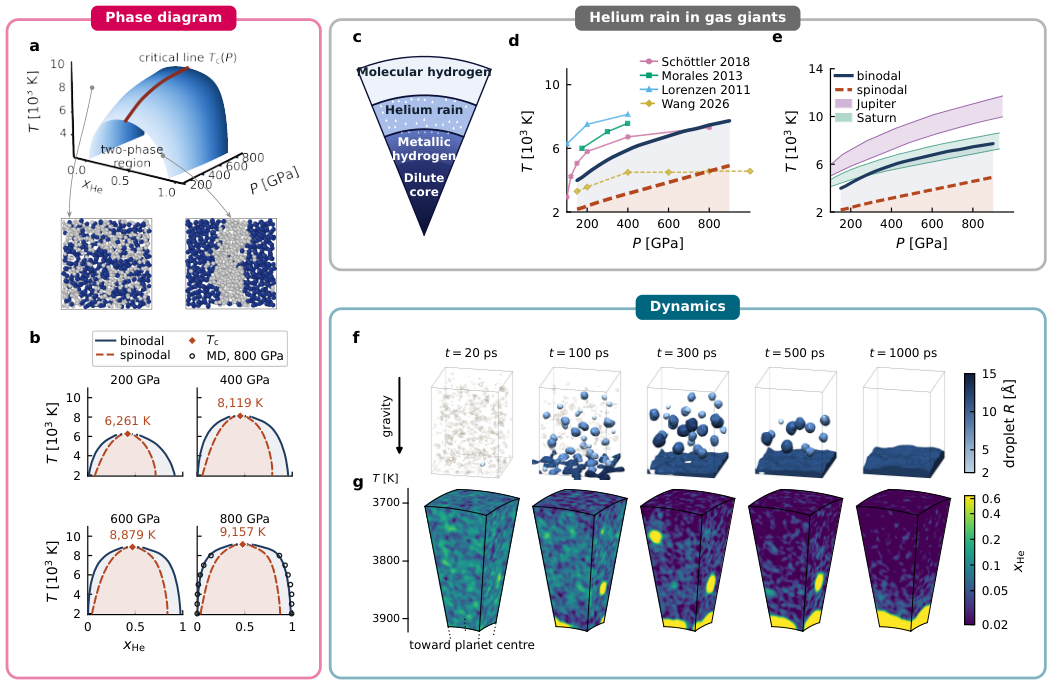
They also applied the models to hydrogen-helium mixtures under extreme planetary conditions. The framework accurately predicted that these elements don't mix, and could even simulate droplet formation and growth across scales involving millions of atoms. Suddenly, we're not just guessing about planetary interiors; we're getting quantum-accurate insights.
This isn't just a clever trick; it’s part of a bigger revolution: building complex models directly from the universe’s fundamental rules. It promises to enhance the fidelity and predictive power of simulations across metallurgy, deep-space chemistry, and beyond. We're moving beyond the child's drawing and the single-atom diagram, toward a future where our computer models can truly see the whole skyscraper, down to its quantum foundations, moving and changing in real time. All because, apparently, we can now teach computers to see the weirdest rules the universe plays by. ◆
Sourced from: "Learning ab initio phase-field models" by Mengyi Chen et al.