
Though AI systems today can accomplish impressive tasks, from booking flights to writing code, their learning often happens in isolation. Think of it like a human learning a new skill. You practice, you make mistakes, you get better. But imagine if every time you started a new project, you had to learn everything from scratch, without notes or memories from past experiences. This is often how AI agents operate today. The specialized functions AI agents use, which we can call their agent skills, develop from insights that are frequently scattered across their individual learning journeys. This makes it difficult for agents to systematically build on what they’ve learned or share those improvements.
This is where a new approach, called WikiSkill, enters the picture. Researchers Liyan Tang and colleagues at Google have developed a framework that allows AI agents to get smarter over time by giving them a shared, persistent knowledge base – much like a Wikipedia. This work recently appeared as a preprint on arXiv. The core idea behind WikiSkill is to gather what an AI agent learns – its agent experience – and continuously refine it into this central knowledge base, the wiki. This is a crucial step because it separates three key elements: the raw interactions an agent has, the consolidated knowledge gained from those interactions, and the actual agent skills it can use to perform tasks.
Think of it this way: when an AI agent performs a task, it generates a lot of raw experience – all the attempts, successes, and failures. Instead of letting this experience fade away or remain trapped in isolated records of its work, WikiSkill systematically processes it. It then takes these lessons and adds them to the persistent knowledge base, the wiki. This wiki becomes a living record, constantly growing and improving. When the agent needs to improve its agent skills, it doesn't start from zero. It draws on this collective wisdom stored in the wiki. This allows for what the researchers call skill evolution – a progressive improvement of the agent's abilities based on accumulated, organized knowledge.
This systematic approach leads to significant gains. WikiSkill consistently outperforms other current methods for improving agent skills. The researchers found that agents using WikiSkill often perform better than agents without these specialized skills, which they measured against comparisons of agents with no skills. A surprising finding was that even smaller AI models, when equipped with these evolved skills, could sometimes achieve better results than much larger models that lacked such specialized capabilities. This suggests that organized, reusable knowledge can be as impactful as raw model size, and that larger models generally gain even more benefit from evolved skills. Now that we have that in place, let's consider a practical challenge for these evolving skills: the transfer of these skills between AI systems. An AI system, whether it’s a virtual assistant or a robotic arm, uses specific instructions to tell its internal language model what to do. These instructions are often sensitive to exact wording and format. This problem – reusing skills across different AI models – is what the SkCC, or "Skill Compiler," project addresses. It creates a universal, underlying representation for skills, which acts like a blueprint. This blueprint describes what the skill does, but does not care about the specific language or format of any particular AI system. This means skills can be authored once and then reliably used across many different agent frameworks. SkCC also helps with security by checking for vulnerabilities before skills are deployed, ensuring that even continuously evolving skills remain safe to use.
With this ability for AI agents to continuously learn and evolve their skills, a critical question arises: what about safety? The paper "Auto-Policy, not Auto-Skill raises a fundamental concern here. While new skills can make agents more efficient, there’s a crucial difference between how an agent can act and what an agent is allowed to do. Imagine an evolving agent skill that learns to perform a physical action, like opening a door. This skill describes the steps to open the door. But who decides when the door should be opened, or whether it should be opened at all? The problem is that a new skill, even an evolved one, might carry an unauthorized claim of permission to act. The agent receiving this skill might not have a built-in way to reject such a claim, potentially leading to unintended or dangerous actions, especially in the physical world. This critique argues that scaling up skill generation without also addressing safety risks scaling up vulnerabilities. To counter this, "Auto-Policy, not Auto-Skill proposes "Edge Skillguard," a system that can reside within the skill itself. It acts like a gatekeeper, checking the real-world situation and sensor data to make sure actions are genuinely authorized and based on verified local evidence.
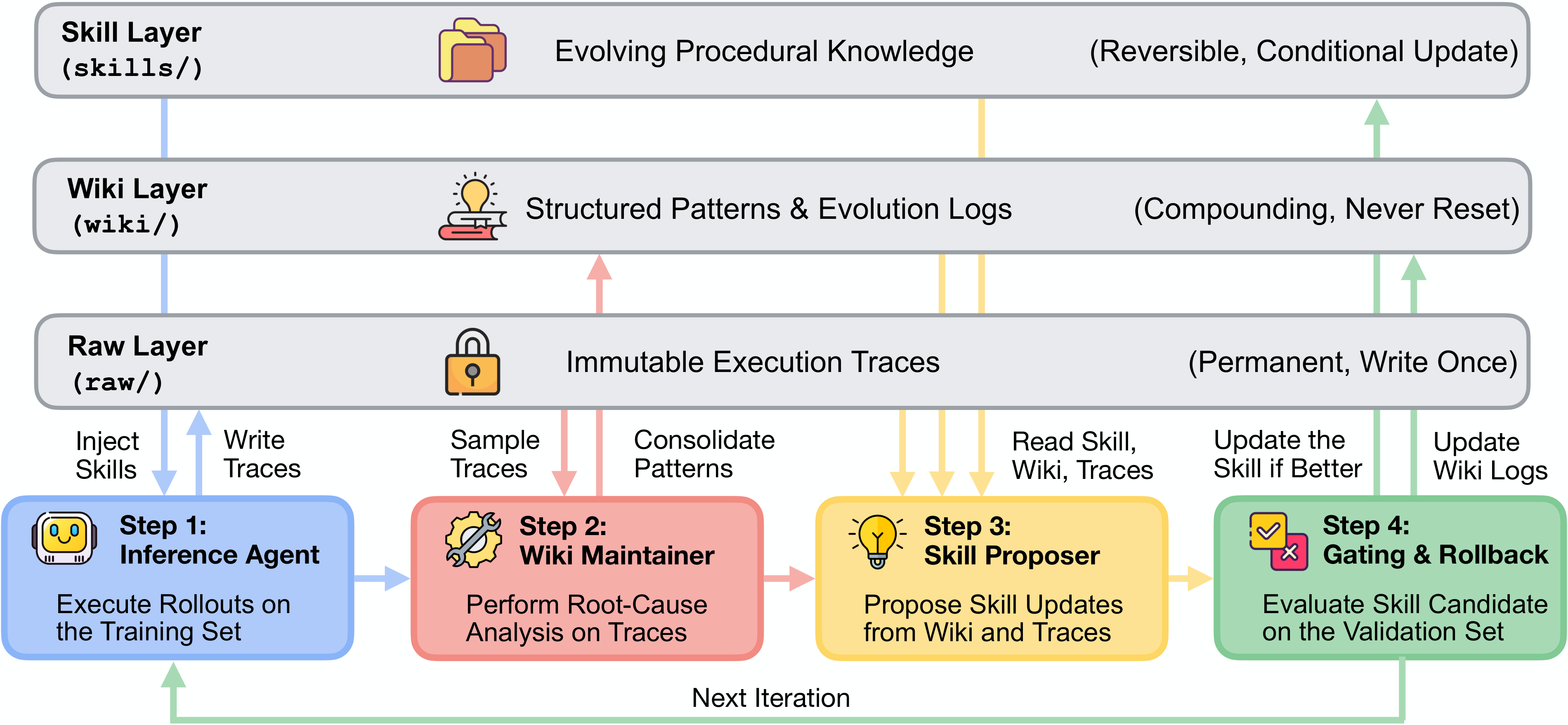
We also see parallel efforts, like the "Anything2Skill framework, which focuses on taking all sorts of external information – like instruction manuals, logs, or recorded demonstrations – and compiling them into structured, executable procedures. Instead of just pulling out fragmented facts, Anything2Skill extracts and organizes the step-by-step knowledge into a permanent "SkillBank." This shows another way scientists are building agents' procedural memories, complementing WikiSkill's focus on learning from agent experience.
The ability for AI agents to continuously evolve and share their agent skills through a persistent knowledge base like WikiSkill promises a new era of capability. We are moving towards agents that do not just learn, but learn better, building on their collective experience. Yet, the road ahead demands careful attention to safety and security. Ensuring that these advanced abilities are coupled with comprehensive policy controls, especially when interacting with the physical world, remains a central challenge. The goal is not just smarter agents, but also safer, more reliable ones – truly understanding the world and acting within clear boundaries. ◆
Sourced from: "WikiSkill: Compiling Agent Experience into Persistent Knowledge for Skill Evolution" by Liyan Tang et al.