
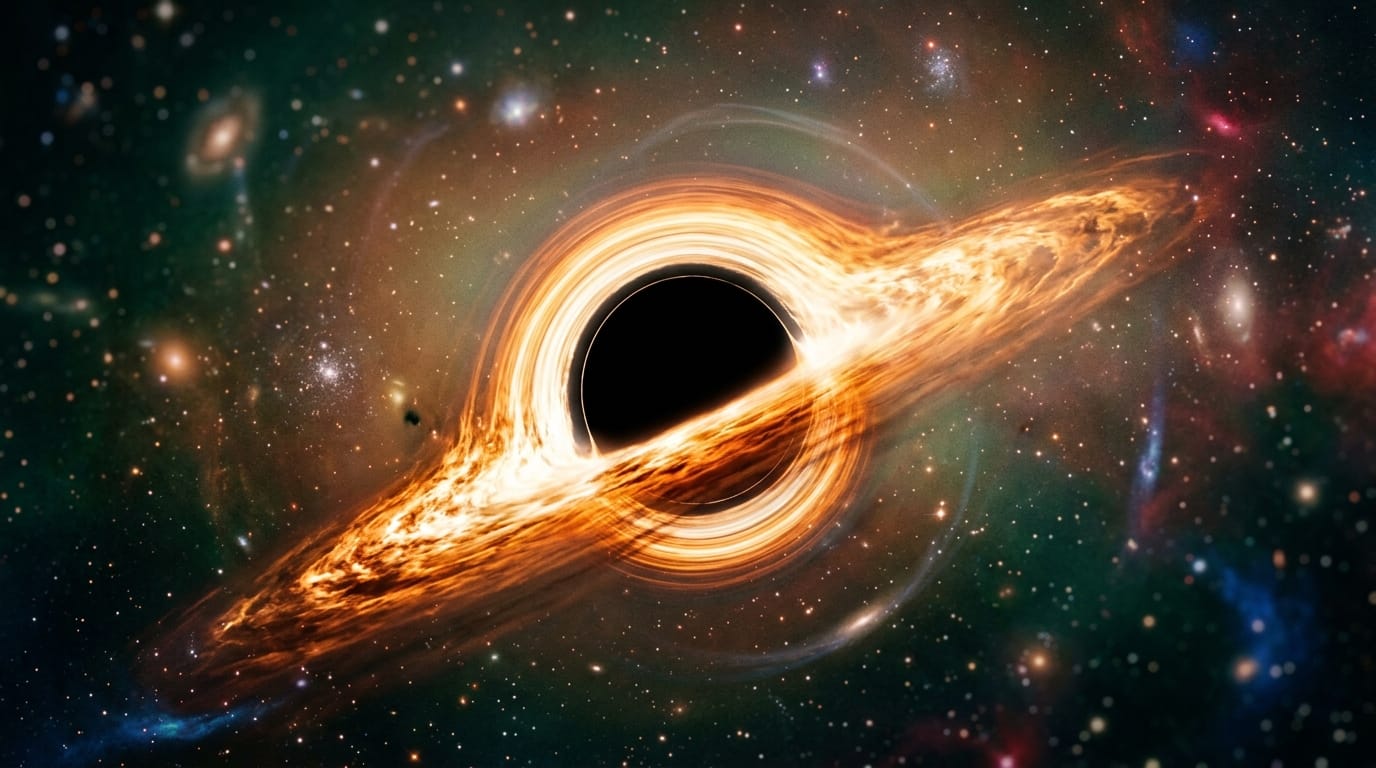
Within the cosmos, its deepest darkness hides in plain sight: a gravity well so profound that nothing, not even light, escapes its grasp. Yet, we have seen it. In 2019, humanity turned a vast, virtual eye toward the galaxy Messier 87, resolving for the first time the precise, lensed shadow of its central supermassive black hole, M87. That image, an asymmetric ring of bright emission, offered direct evidence for these colossal objects and affirmed decades of intricate theoretical work on gravity's strange bending of light. This was not a quick glance, but a careful, Earth-spanning act of attention.
To achieve this, the Event Horizon Telescope, or EHT, stitched together data from radio telescopes scattered across the globe. This network of observatories, operating at a wavelength of 1.3 millimeters, creates a single virtual dish as wide as our planet. Such a setup provides extraordinary angular resolution, allowing scientists to discern details as fine as tens of microarcseconds—the equivalent of reading a newspaper in New York from a sidewalk café in Paris.
Despite this intricate machinery, the task of imaging a black hole remains fraught with difficulty. The signals arriving from these cosmic depths are faint. Compounding this challenge, the individual telescopes in the array are separated by immense distances, leaving vast gaps in the data coverage. And still, the observations themselves are subject to what scientists call calibration uncertainties, small measurement inaccuracies that can creep into the data from each individual telescope, potentially clouding the final picture.
These measurement issues pose a particular problem for reconstructing subtle features around a black hole, like the faint, swirling patterns of light that reveal its magnetic fields or the complex motions of superheated gas. When the raw data is this sparse and uncertain, the methods used to fill in the blanks and create an image become critical. Rigorous procedures are essential to ensure that what we see reflects the cosmos, not merely our own assumptions.
Now, a new approach promises to refine this difficult task, offering an independent way to interpret the EHT’s observations. A team including Nithyanandan Thyagarajan and colleagues, in a preprint appearing on arXiv, describes a framework built to be intrinsically resilient to many of the typical measurement inaccuracies. Their method hinges on a specific type of data measurement known as closure invariants. These are not direct measurements of brightness at a single telescope, but rather complex mathematical combinations of signals across three or more telescopes. The key insight is that many common calibration errors that affect individual telescope measurements simply cancel out when these closure invariants are calculated. They offer a purer, more stable glimpse into the object’s structure. The researchers combined these stable closure invariants with a novel deep learning system called Generative Deep learning Image Reconstruction with Closure Terms, or GenDIReCT. Imagine a system that has learned the general properties of valid images from countless examples. GenDIReCT operates in what is called the latent space of images—an abstract mathematical realm where the fundamental components and patterns of images are represented in a compact form. The system is then guided by the closure invariants, using this robust, error-immune data to generate a new image within that abstract space, gradually diffusing an initial noise pattern into a coherent picture. This careful process allows the framework to reconstruct clear images even when the raw data is sparse and noisy, essentially filling in the missing information based on the reliable invariants and its own learned understanding of image structure.
This independent method has been tested not only on artificial datasets designed to challenge imaging systems, but also on real EHT data from cosmic radio sources like 3C279 and Centaurus A. Applying GenDIReCT to the public EHT datasets for both M87 and Sagittarius A—the supermassive black hole at the center of our own Milky Way—has yielded reconstructions that align well with previously reported images, strengthening confidence in the general features observed.
The ability to derive such images through multiple, independent analytical pathways is crucial. The first image of Sagittarius A, unveiled in 2022, revealed a compact, variable ring, also consistent with a Kerr black hole, similar in shape but differing in dynamics from M87*. Comparing these two black holes, which differ in mass by more than three orders of magnitude, offers profound tests of general relativity across vast scales. This independent imaging method helps to confirm that what we see is truly the imprint of gravity, and not an artifact of our tools. It extends our human attention further into the structure of reality itself, making the unseen visible, allowing us to see the deep cosmic past with ever greater clarity. ◆
Sourced from: "Towards independent event horizon imaging of the supermassive black holes in M87 and the Milky Way" by Nithyanandan Thyagarajan et al.